-


-


-
 ALL CATEGORIES
-
-
-
-
-
-
SLEW SYSTEM
-
-
-
-
-
AXLES
- TIE RODS
- KIT SPIDER FOR DRIVE SHAFTS
- DIFFERENTIAL
- MOUNT THE KNUCKLE
- KIT SPIDER FOR AXLE SHAFTS
- HUB / GEAR REDUCTION
- PROPSHAFTS
- SOLENOID VALVES / COILS
- FLANGES / COUPLING YOKES
- BEARINGS
- BUSHES / WASHERS MOUNT AXLE
- AXLE / DIFFERENTIAL HOUSING
- DRIVESHAFTS / CENTER JOINTS
- BOLTS / NUTS / STRAPS
- LOCK / CIRCLIP / CLIP
- CROWN WHEEL AND PINIONS
- SEALS
- OTHERS
-
-
-
-
-
-
-
-
ENGINE
-
-
-
-
-
COILS / SOLENOID VALVES
-
SWIVELS / TURNING JOINTS
-
PUMPS / STEERING VALVES / MOTORS
-
-
-
VALVES
-
HYDRAULIC HOSES / PIPES
-
RAMS
-
ACCUMULATORS
-
QUICKHITCHES
-
-
-
BOLTS / NUTS / WASHERS
-
PUMP DRIVESHAFTS
-
SEALS VALVES / PUMPS
-
OTHERS
-
-
-
-
-
-
-
TIMING
-
EQUIPMENT
-
-
LUBRICATION SYSTEM
-
-
INDUCTION / EXHAUST SYSTEM
-
SEALS / GASKET SETS
-
ENGINE MOUNTING
-
SERVICE TOOLS
-
-
-
-
-
-
STABILIZERS
-
-
-
-
-
-
FUSES / FUSE BOXES
-
RELAYS / FLASHERS
-
REVERSE ALARM
-
-
HEATERS / BLOWERS
-
BATTERY ISOLATER SWITCH
-
-
-
-
-
OILS
-
FLUIDS
-
-
-
PAINTS
-
-
-
-
-
-
-
GLASS / CAB GLAZING
-
-
-
RUBBER SEALS - GLASS
-
ASSEMBLY KITS / ADHESIVES
-
-
-
-
-
ADAPTERS
-
BOLTS / LOCKS
-
-
-
-
HYDRAULIC INSTALLATIONS
-
TOEPLATES
-
TOOTH RIPPER
-
-
-
HYDRAULIC HAMMERS / TOOLS
-
PLOWS
-
QUICKHITCHES
-
FORKS
-
-
-
EARTH DRILL / AUGER
-
SWEEPER / COMPONENTS
-
SWINGOTILT / PLATFORMS
-
-
-
-
-
ACCESSORIES
-
DECAL / STICKERS
-
-
-
GADGETS
-
CLOTHES
-
FAN ZONE
-
-
-
 BODYWORK
 UNDERCARRIAGE
 TRANSMISSION / AXLES / WHEELS
 STEERING / CONTROL
 HYDRAULICS
 BRAKES
 ENGINE
 ARMS / SWING / STABILIZERS
 ELECTRICS
 OILS / FLUIDS / LUBRICANTS / PAINTS
 FILTERS
 GLASS / CAB GLAZING
 TEETH / ADAPTORS / PIN LOCKS
 ATTACHMENTS
 ACCESSORIES / TOOLS



How to Choose a Bucket Cutting Edge? Steel, Types, Replacement – The Complete Guide
How to Choose a Cutting Edge for a Bucket? Steel, Types, Replacement – A Complete Guide
The Cutting Edge: An Unsung Hero of Efficiency and Savings
Choosing the right cutting edge for an excavator, loader, or mini-excavator bucket is one of those decisions that has a disproportionately large impact on job profitability. The cutting edge, which is the replaceable cutting part, is the first line of attack on any material – from loose sand to compacted clay and rubble. It determines the ease of digging into the ground, which directly translates to fuel consumption, work speed, and the load on the entire machine. Neglecting its condition or making a poor choice is a direct path to damaging the much more expensive bucket and causing unnecessary downtime. In this complete guide, we will discuss every aspect of cutting edges, from metallurgy to installation techniques, so you can make informed and profitable decisions.
Anatomy of a Cutting Edge and Its Role in the Working System
A cutting edge is much more than just a "blade." It is a precisely engineered component with multifaceted tasks:
- Ground Penetration: The sharp, properly profiled edge (bevel) of the cutting edge acts like a knife that "cuts" the material before the rest of the bucket. This significantly reduces cutting resistance, allowing the machine to work with less effort and consume less fuel.
- Bucket Protection: The cutting edge is intentionally designed as a wearable part. It takes 100% of the abrasion, thereby protecting the bucket's body, which is much more expensive to repair or replace. Replacing a cutting edge for a few hundred zlotys is incomparably cheaper than reconditioning the entire bucket for several thousand.
- Foundation for Teeth: In digging and many loader buckets, the adapters for mounting teeth are welded to the cutting edge. Its rigidity and strength are crucial for the stability of the entire tooth system.
- Finishing Tool: In grading buckets, the perfectly straight edge of the cutting edge is indispensable for precise terrain profiling, leveling, and finishing work.
Material Matters: Why Not All Steel Is Created Equal
Two cutting edges can look identical, yet one might last a month while the other lasts a year. The difference lies in the steel's structure, invisible to the naked eye, and its treatment process.
Key Parameter: Hardness on the Brinell Scale (HB)
The hardness of steel is measured on the Brinell scale (HB). The test involves pressing a steel ball of a specific diameter into the material with a specific force. The smaller the indentation, the harder the material. Regular structural steel (S355) has a hardness of about 180-200 HB. High-quality cutting edges made of wear-resistant steel reach a hardness of 450-550 HB. This means they are more than twice as resistant to abrasion.
1. Wear-Resistant Steel (Hardox, Raex, Borox) – The Gold Standard
This is a group of steels that owe their properties to a precise chemical composition and a hardening process. They are extremely hard on the surface, which protects them from abrasion, while maintaining a certain flexibility in the core. This "toughness" of the core is crucial – it prevents the cutting edge from cracking under the impact of sudden blows from rocks or curbs. Cutting edges with a hardness of 500 HB (like Borox 500) are the ideal compromise between extreme abrasion resistance and fracture toughness.
2. Boron Steel – Maximum Hardenability
The addition of boron (even in trace amounts) to the steel alloy radically increases its hardenability. This means that the hardness achieved in the heat treatment process is deeper and more uniform. Boron steel cutting edges offer exceptional wear resistance and are the ideal solution for operators who expect maximum reliability in the toughest conditions – in mines, quarries, and when working with highly abrasive materials.
3. Carbon Steels (Structural) – A False Economy
The cheapest cutting edges on the market are often made of ordinary structural steel. Although they are tempting with their low price, their hardness is incomparably lower. They wear out at an express rate, requiring frequent replacements. Over a few months, the cost of downtime and multiple replacements far exceeds the one-time expense for a cutting edge made of true wear-resistant steel.
A Detailed Guide to Types of Cutting Edges
The choice of a cutting edge depends not only on the material but also on its shape and purpose. Each type has been designed to maximize performance in specific applications.
1. Double Bevel Cutting Edge (Reversible) – The King of Economy
Construction: Its most characteristic feature is having two identical, beveled (angled) working edges. It is usually bolted to the bucket using plow bolts with a countersunk head that sits flush with the surface of the cutting edge.
Application: This is the absolute standard in multi-purpose buckets (4-in-1) of backhoe loaders, such as the JCB 3CX/4CX or CAT 428/432, as well as in standard wheel loader buckets. Their main task is to work on hard, flat surfaces – pushing, leveling, and loading loose materials from paved areas. The bevel on the edge makes it easier to "slide" under the material.
Key Advantage: The ability to be reversed. When the first edge becomes dull, the operator can unbolt the cutting edge, rotate it 180 degrees, and work on the second, new edge. This simple solution doubles the lifespan of a single component, making it extremely cost-effective.
2. Single Bevel Cutting Edge – The Master of Precision
Construction: It has only one cutting edge, beveled at a sharp angle. The other side is flat, ensuring a perfect fit against the bucket's structure. It is usually welded on.
Application: This is the standard choice for grading buckets on excavators. The sharp, single edge provides excellent precision when profiling terrain, grading slopes, and cleaning ditches. It is a tool for finishing work where clean and accurate cuts are important.
Important Note: Because it is welded to the bucket, its replacement is more labor-intensive and requires workshop intervention.
3. Serrated Cutting Edges (Segmented) – More Aggression
Construction: This is not a single, solid bar. It consists of shorter segments, often in a "V" shape (so-called "delta" blades) or with integrated teeth, which are bolted next to each other across the entire width of the loader bucket.
Application: Ideal for working in hard, compacted materials (e.g., clay, compacted gravel) where a smooth cutting edge begins to slip. The serrated edge acts like a saw, biting into the material and making it easier to "break off." It is an excellent compromise between a smooth cutting edge and a full system of teeth on adapters.
How to Choose the Perfect Cutting Edge? A Step-by-Step Guide
Choosing a cutting edge is a process that requires answering a few key questions. A wrong decision can lead to buying a part that doesn't fit or will be destroyed after a few days.
Step 1: Identify the Machine and Bucket Type
You will use a different cutting edge for a loader bucket than for a grading bucket.
Loaders and backhoe loaders (front bucket): Thick, bolt-on, double bevel cutting edges are most commonly used here. In models like the JCB 3CX or CAT 428, a cutting edge with a thickness of 16-20 mm and a width of approx. 2350 mm is standard.
Excavators (grading buckets): Here, welded, single bevel cutting edges, matched to the width of the bucket, are king.
Mini-excavators: Due to lower forces, the cutting edges are thinner (10-12 mm), but still made of wear-resistant steel.
Step 2: Measure Your Old Cutting Edge
Never buy by sight!
Even within the same machine model (e.g., JCB 3CX), different types of buckets with different cutting edges may have been used over the years. Measuring the old cutting edge is the surest way to avoid a mistake.
You need four key dimensions:
1. Length (L): The total length of the cutting edge.
2. Width (W): The width from the cutting edge to the back edge.
3. Thickness (T): The thickness of the material.
4. Hole spacing: This is a critical dimension. Measure the distance from the side edge to the center of the first hole, and then the distances between the centers of the subsequent holes. Also, measure the diameter of the holes and make sure they are suitable for countersunk (plow) bolts.
Step 3: Choose the Appropriate Steel Hardness
Work in light conditions (soil, sand, agriculture): A cutting edge with a hardness of HB400 will be sufficient.
Work in mixed conditions (clay, gravel, occasional rubble): The absolute minimum is HB450. This is the most versatile choice.
Work in heavy conditions (quarries, rubble, hard rock): Only and exclusively HB500. A cutting edge with a lower hardness will be destroyed in a very short time.
Replacing the Cutting Edge – A Professional Step-by-Step Guide
Replacing a bolt-on cutting edge is a task that can be done in the field, but it requires precision, the right tools, and strict adherence to safety rules.
Essential Tools and Preparation
- Impact wrench: Loosening seized and tightly torqued plow bolts by hand is almost impossible. You will need a powerful impact wrench (pneumatic or electric) with the appropriate socket.
- Hammer and chisel: To knock out stubborn bolts.
- Penetrating oil (rust remover): Essential for loosening corroded threads.
- Wire brush / angle grinder with a flap disc: For thoroughly cleaning the bucket's mounting surface.
- New set of bolts and nuts: Absolutely essential.
Replacement Instructions
- Secure the machine: Position the bucket stably on a level and hard surface, tilting it slightly to have easy access to the bolts from underneath. Turn off the engine and secure the machine against accidental movement.
- Clean and prepare the bolts: Thoroughly clean the bolt heads and threads of dirt and rust. Generously spray all bolts and nuts with penetrating oil and wait for several minutes.
- Remove the old cutting edge: Using an impact wrench, loosen the nuts. If a bolt spins in its seat, you may need to hold it from the top. In extreme cases, seized bolts will need to be cut off.
- Clean the mounting surface: This is a critical step! Remove the old cutting edge and use a wire brush or grinder to thoroughly clean the contact surface on the bucket. It must be perfectly flat, free of rust, and old metal residue.
- Install the new cutting edge: Place the new cutting edge and insert the new plow bolts through the holes. Make sure the countersunk heads of the bolts fit perfectly into the recesses in the cutting edge.
- Tightening: Put on the new nuts and tighten them preliminarily. Then, using a torque wrench, tighten them in a cross pattern to the manufacturer's recommended torque. This will ensure even pressure and prevent the cutting edge from cracking.
Reconditioning vs. Replacement – A Cost-Benefit Analysis
When a cutting edge is worn, we face a dilemma: recondition it by hardfacing, or replace it with a new one? The answer depends on the degree of wear and the costs.
When Does Reconditioning (Hardfacing) Make Sense?
Hardfacing involves applying a new, hard layer of material to the worn edge by welding. It is cost-effective when:
- The wear is even and does not affect the area around the mounting holes.
- The cutting edge has no cracks or deformations.
- We have access to a qualified welder and the appropriate, expensive hardfacing electrodes.
Note: Welding Hardox-type steel requires specialized knowledge, including preheating the material before welding to avoid cracks.
When is Replacement a Better Choice?
In most cases, replacing with a new, high-quality cutting edge is a faster, more reliable, and often cheaper solution in the long run. It is a necessity when:
- The cutting edge is cracked, bent, or worn to the point that it has exposed the bucket body.
- The bolt holes are "worn out" or oval-shaped.
- The cost of labor and materials for professional hardfacing approaches the price of a new cutting edge.
FAQ - Extended Questions and Answers
1. What are the most important criteria when choosing cutting edges for construction machinery?
The most important criteria are: 1. Material hardness (e.g., HB500), 2. Type of cutting edge (double bevel, single bevel), 3. Thickness and width, 4. Fit to the bucket (hole spacing and diameter).
2. Why do I have to use new bolts? Aren't the old ones good enough?
No. Plow bolts work in extreme conditions and are subject to fatigue and stretching. Reusing old, weakened bolts risks them breaking during operation, which can lead to losing the cutting edge and damaging the bucket.
3. I bought a cutting edge, but the holes are off by a few millimeters. Can I "file them out"?
Absolutely not! Cutting edges are hardened. Any hot mechanical processing (with a torch) or intense cold processing (grinding) destroys the hardened zone around the hole, weakening the material and leading to cracking.
4. Can I weld adapters and install teeth on a double bevel cutting edge?
It is technically possible, but not recommended. Bolt-on cutting edges are designed to handle different loads. Welding adapters in a workshop setting, without the proper technology, can weaken the cutting edge and lead to it cracking.
5. What are "side cutters" and do they replace the cutting edge?
Side cutters are components bolted to the side walls of the bucket that protect it from wear when digging in tight trenches. They do not replace the main cutting edge but work in conjunction with it.
6. What is the difference between a cutting edge for a 3CX and a 4CX bucket?
The main difference is the width. The bucket on a 4CX model is wider, so it requires a longer cutting edge. You should always choose a cutting edge for the specific model and width of the bucket.
7. My cutting edge is wearing unevenly, more on one side. What is the cause?
The most common cause is wear on the pins and bushings in the bucket linkage, which causes it to be "askew" during operation. It could also be due to the operator's technique, constantly working at one angle.
8. Is a thicker cutting edge always better?
Not necessarily. A thicker cutting edge is more durable, but it is also heavier and has a duller angle of attack, which can make penetration difficult in hard ground and increase fuel consumption. The thickness should be optimized for the machine's power and the type of work.
9. What is a "blade for teeth"?
This is a cutting edge that is factory-prepared (thinner at the edge) for welding on adapters. It has a different geometry than a standard smooth cutting edge.
Is your cutting edge worn out? Don't destroy your bucket and waste fuel!
A properly selected cutting edge is an investment that pays for itself every day. In our offer, you will find a wide range of HIMACORE brand cutting edges, made from the highest quality wear-resistant steel, suitable for JCB, CAT, Volvo machines, and many others. Contact us, and we will help you choose the perfect cutting edge for your bucket!
Related posts
 How to Correctly Measure and Read a Rubber Track Size? A Step-by-Step Guide.
Buying the wrong tracks is a costly mistake. Our simple, step-by-step guide will teach you how to independently...
Read more
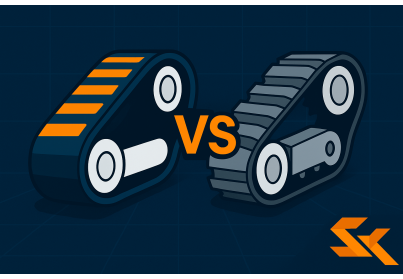 Rubber Tracks vs. Steel Tracks? A Guide to Choosing the Best for Your Machine
Choosing between rubber and steel tracks is a key decision that affects costs and work efficiency. Learn the key...
Read more
 Anatomy of a Tracked Undercarriage – Get to Know Rollers, Sprockets, Idlers, and Chains
If the engine is the heart of a machine, the undercarriage is its legs. Understanding its construction is key to...
Read more
 Adjusting Track Tension – The Key to a Long Undercarriage Life
A track that is too loose or too tight is a direct path to a costly failure. Our step-by-step guide will show you how...
Read more
 7 Operator Mistakes That Destroy a Tracked Undercarriage
The undercarriage can account for up to 50% of a machine's maintenance costs. Many of these are due to bad habits....
Read more
WE OFFER PRODUCTS OF THE BEST BRANDS



















SERWIS KOP Sp. z o.o. Sp.k.
ul. Podkarpacka 57A, 35-082 Rzeszów
NIP: 813-352-97-49 REGON: 180286726
Opening hours
Telephone support - Monday - Friday (8:00 AM – 5:00 PM)
Order pick-up - Monday - Friday (8:00 AM – 4:30 PM)
Email
[email protected]
[email protected]
Gadu-Gadu communicator
GG: 4185846 - Daniel
ul. Podkarpacka 57A, 35-082 Rzeszów
NIP: 813-352-97-49 REGON: 180286726
Opening hours
Telephone support - Monday - Friday (8:00 AM – 5:00 PM)
Order pick-up - Monday - Friday (8:00 AM – 4:30 PM)
[email protected]
[email protected]
Gadu-Gadu communicator
GG: 4185846 - Daniel
Phone
+48 17 864 31 00
+48 17 864 00 24
+48 17 864 25 96
Mobile phone
+48 607-700-547
+48 695-944-818
+48 691-330-531
+48 690-906-751
Fax
+48 17 864 31 20
+48 17 864 31 00
+48 17 864 00 24
+48 17 864 25 96
Mobile phone
+48 607-700-547
+48 695-944-818
+48 691-330-531
+48 690-906-751
Fax
+48 17 864 31 20